
The internet is not short on content.
It’s short on authenticity.
Every day, millions of articles are published—many of them written to chase algorithms instead of serve people. Yet the irony is this:
Search engines are now actively rewarding authenticity.
But there’s a second truth that’s just as important—and often ignored:
Authentic content without optimization is invisible.
You can write the most meaningful article of your life, but if your website is not structured, optimized, and understood by search engines, the internet has no way to introduce your work to the people who are already looking for it.
This article breaks down why authenticity matters, why optimization is still essential, and how three real websites—at very different stages—prove that the internet still works for creators who do it right.
The Shift: From Keyword Stuffing to Real Value
There was a time when ranking online meant:
- Stuffing keywords into every paragraph
- Writing for bots instead of humans
- Publishing thin, repetitive content
That era is over.
Modern search engines now look for:
- Original insights
- Clear intent
- Human engagement
- Topical authority
- Trust signals over time
In other words, the internet wants content written by real people for real people.
But authenticity alone doesn’t guarantee discovery.
Why Good Content Still Fails to Get Traffic
This is where many creators get frustrated.
They say:
- “My content is good, but no one reads it.”
- “I’m consistent, but traffic is flat.”
- “Search engines are unfair.”
In most cases, the issue isn’t the content—it’s the infrastructure.
Common problems include:
- Slow-loading pages
- Poor site structure
- No internal linking strategy
- Missing metadata
- No clear topical focus
When this happens, search engines can’t:
- Understand what your site is about
- Decide who to show it to
- Trust it enough to recommend it
Optimization is not manipulation.
It’s communication.
Case Study #1: Dennis.tips — Starting From Zero
Website: Dennis.tips
Purpose: Personal insights, digital strategy, faith, and practical wisdom
Launch: Last year
Audience at launch: Zero
When Dennis.tips launched, there was:
- No social media push
- No ads
- No email list
- No backlinks
Just authentic writing and intentional structure.
The Content Strategy
- Real experiences
- Clear opinions
- Practical lessons
- Long-term consistency
Today, Dennis.tips has:
- 157 published blog posts
- Clear topical clusters
- Internal linking between related ideas
The Results
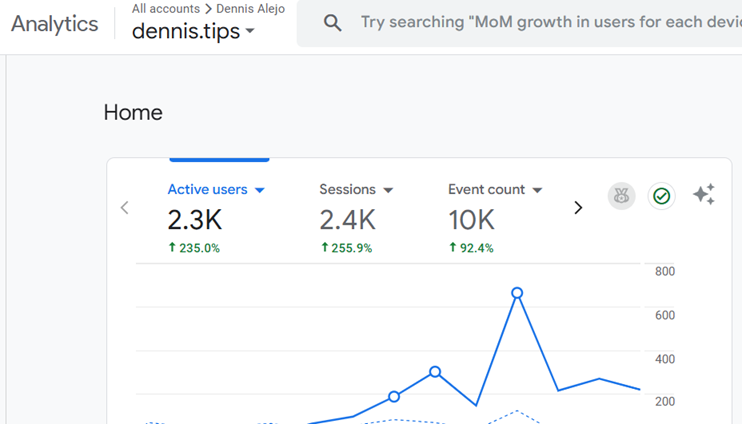
Monthly analytics show:
- 2.3K active users
- 2.4K sessions
- 10K+ event counts
This growth didn’t happen overnight.
It happened because the site:
- Earned trust gradually
- Stayed consistent
- Communicated clearly with search engines
Small sites grow when they stop trying to sound big and start being real.
Case Study #2: iRank.page — Brand-New Domain, No Promotion
Website: iRank.page
Domain age: Brand new
Marketing: None
Followers: None
iRank.page proves a powerful point:
New domains are not invisible—irrelevant ones are.
The Strategy
- Build pages around real search intent
- Avoid fluff
- Focus on usefulness
- Optimize every page correctly
The Scale
- 450 pages
- Each page answers a specific question
- Clear structure and performance optimization
The Results
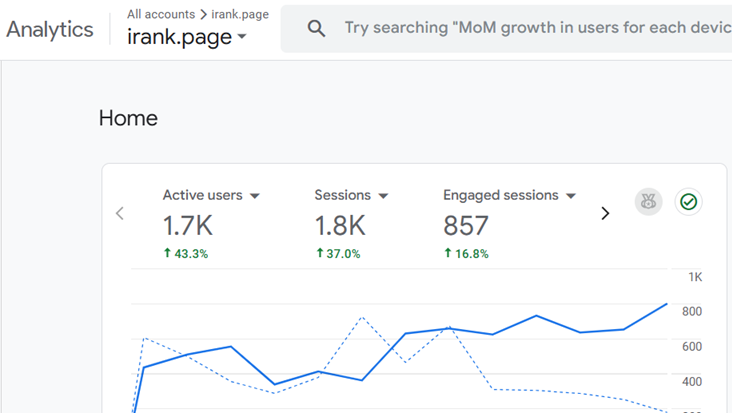
Monthly metrics show:
- 1.7K active users
- 1.8K sessions
- 858 engaged sessions
What “Engaged Sessions” Tell Us
This means users are:
- Staying on the site
- Interacting with tools or content
- Exploring multiple pages
In other words, the internet isn’t just sending traffic—it’s sending the right traffic.
Case Study #3: ElderIndustry.com — The Power of Authority
Website: ElderIndustry.com
Pages: ~70
Monthly active users: 15K
Sessions: 16K
Engaged sessions: 4K
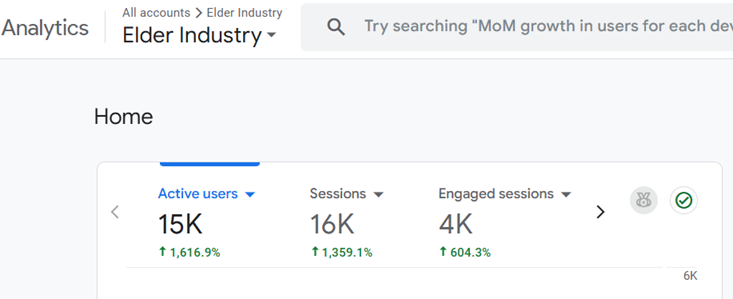
This website belongs to a retired client who spent her life building authority in a very specific niche.
Why This Site Performs Differently
- The domain has existed since 1980
- The owner is a respected author
- The site has decades of trust and backlinks
- There is a built-in audience
Despite having fewer pages, the site receives significant organic traffic.
Authority compresses effort.
When trust is already established, every piece of content travels further.
Interestingly, this domain is still for sale, which shows how valuable authority-based domains remain—even today.
Three Websites, One Core Lesson
Let’s put them side by side:
| Website | Domain Age | Pages | Monthly Users | Primary Advantage |
|---|---|---|---|---|
| Dennis.tips | New | 157 | 2.3K | Consistency |
| iRank.page | Brand new | 450 | 1.7K | Relevance |
| ElderIndustry.com | Decades old | 70 | 15K | Authority |
Different paths.
Different timelines.
Same foundation.
Authentic content + optimization = audience.
What Optimization Really Means (Without Jargon)
Optimization doesn’t mean tricking search engines.
It means:
- Fast-loading pages
- Clear headings
- Logical navigation
- Helpful internal links
- Accurate tracking and analytics
- Content that matches user intent
When done correctly, optimization simply removes friction.
The Internet Is Already Listening
People are searching every day for:
- Answers
- Guidance
- Insight
- Experience
If your content is authentic, they want to find you.
But the internet can’t recommend what it doesn’t understand.
So write honestly.
Build thoughtfully.
Optimize clearly.
You don’t need to go viral.
You need to be discoverable.
And when you are, the audience comes.